Why Indian Roads Crumble Every Monsoon (The Real Reasons)
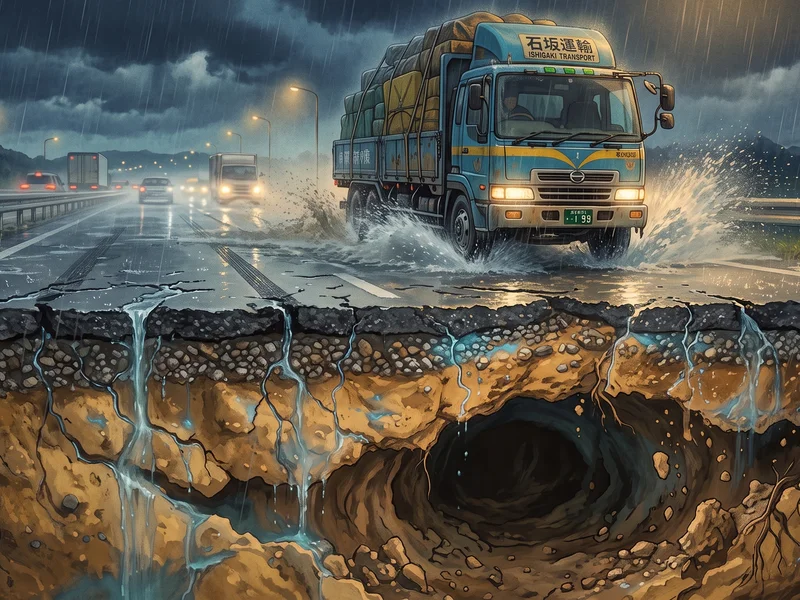

Every July, the same scene plays out across Indian cities. A freshly laid stretch of black bitumen looks perfect on inauguration day. Traffic moves smoothly for a few weeks. Then the monsoon hits, and the surface splits open into craters that swallow tires and snap axles.
The public blame usually lands on two targets: the rain and the contractor. But heavy rain falls on plenty of tropical countries whose highways don’t fall apart in a month. So what’s actually happening under the asphalt?
Dig into research from India’s civil engineering institutes and there’s no single culprit. It’s a mix of physics, cheap materials, missing drainage, and a tender system that rewards the lowest bidder over the best builder. Here’s how each piece plays into the collapse.
The Fourth Power Law: why overloaded trucks do so much damage
Blaming heavy trucks for broken roads can sound like a convenient excuse for bad contractors. But the underlying math is real.
Pavement engineering runs on the Fourth Power Law, a principle from the AASHO Road Test conducted in the late 1950s. It states that the damage a vehicle causes to a road rises roughly to the fourth power of its axle weight.
In plain terms: double the load on an axle, and you don’t double the damage. You multiply it by 16.
The Indian Roads Congress has noted that an axle carrying twice its legal limit can cause 16 to 60 times the structural damage of a standard 8.1-tonne axle. On Indian highways, two-axle trucks hauling 35 tonnes gross weight, well past the legal limit, are a routine sight. The Central Road Research Institute estimates that severe overloading can speed up pavement failure by 10 to 20 times the normal rate. Roads built for standard commercial traffic are absorbing industrial-scale stress.
The material problem: roads built to fail
If overloading is the hammer, weak construction is the glass waiting to break. A lot of Indian municipal roads are structurally compromised before a single truck ever drives over them.
Water-trapping mixes. Engineers have options when choosing a bituminous mix. Dense-graded mixes hold up for 7 to 8 years. Cheaper alternatives like Bituminous Macadam or Semi-Dense Bituminous Concrete let water seep in and often fail within 1 to 2 years. Contractors pick these because they cut the initial tender cost, not because they last.
Self-certification. How do these roads get approved in the first place? A 2019 review of civic roads in Mumbai found that nearly a third of new stretches failed basic core-cut density tests. The oversight system lets contractors certify their own work, with little independent checking.
The kickback economy. Structural weakness traces back to money. Investigative reporting out of Bengaluru quoted contractors admitting to paying up to 40% of a contract’s value in kickbacks just to win the job. Squeeze margins that hard and quality materials disappear. Some contractors swap proper bitumen emulsion for cheaper substitutes like kerosene, which strips the asphalt of its binding properties and all but guarantees it will crumble.
The drainage deficit: water as the real enemy
Want to kill a bitumen road fast? Let water sit on it.
Bitumen repels water on its own. But once traffic or heat fatigue opens up micro-cracks, water gets in and breaks the bond between the bitumen and the crushed stone underneath. The CRRI estimates standing water alone can cut a pavement’s lifespan by up to 40%.
In the Netherlands, engineers design the drainage system before laying a single pavement layer. In India, drainage is often an afterthought: drains are missing, poorly graded, or clogged with plastic waste. When water can’t run off the camber into a drain, it pools on the surface and works its way into the subgrade below.
Calling this a monsoon problem misses the point. It’s a planning failure that shows up during the monsoon.
How a smooth road turns into a crater
The chain reaction behind a pothole is mostly invisible until the very end:
- Rainwater gets into the asphalt through micro-cracks or poorly sealed joints.
- Water reaches the subgrade, the soil foundation under the road, and turns it to mud.
- An overloaded truck drives over the now-soft section, and the asphalt flexes downward under the weight.
- Repeated flexing pumps soil and water out from under the road, leaving a hollow void beneath the surface.
- The unsupported asphalt finally gives way under a tire and collapses inward.
The pothole didn’t form overnight. The damage happened underground weeks earlier. The rain just triggered the visible collapse.
Both explanations are true at once
Overloading is a real, measurable stressor. But the reason Indian roads can’t absorb that stress the way a German autobahn handles heavy freight is that the baseline construction is weak to begin with: thin mix designs, poor compaction, bad drainage, and materials cut corners on.
Put an illegally overloaded 35-tonne truck on a structurally weak, waterlogged road, and failure isn’t just likely. It’s close to guaranteed.
What would actually fix this
India has the engineering talent and the budget to build roads that last. What’s missing is enforcement.
- Independent audits. End self-certification. Core-cut density tests should be run by third-party labs before any contractor gets paid.
- Drainage first. No road project should be approved without a working, verified drainage plan.
- Automated weight enforcement. Weigh-in-motion sensors at toll plazas can fine overloaded trucks automatically, cutting out the human step where bribery happens.
- Performance-based contracts. Bind contractors to maintain the road for 5 to 7 years. If a pothole shows up in year two, the repair comes out of their pocket, not the taxpayer’s.
Key takeaways
- Road damage scales roughly with the fourth power of axle weight. A truck carrying double its legal limit can cause up to 60 times more damage.
- Kickbacks push contractors toward cheap, water-trapping mixes like BM and SDBC, and toward skipping proper compaction.
- Standing water alone can cut a road’s life by 40%. Potholes form when water destroys the subgrade beneath the asphalt.
- Indian roads fail because weak construction creates the openings that overloaded trucks then exploit.
FAQ
Why do potholes seem to appear overnight when it rains? The real damage, micro-cracks and a weakened subgrade, builds up over months. Rain just washes away the loose material and lets the unsupported surface collapse.
Are overloaded trucks really that damaging to roads? Yes. A 10% to 30% increase in axle weight can cut a road’s lifespan by a significant margin, because of how sharply pavement damage scales with weight.
Why not just build every road out of concrete? Concrete holds up well against water and lasts longer, but it costs more upfront, is harder to repair, and makes frequent utility digging (water lines, fiber optics) far more disruptive in dense urban areas.
Have you got a stretch of road in your city that fails like clockwork every year? Tell us about it in the comments, and share this if you want more people talking about the real reasons behind it.
Related Articles



Never miss an update
Join 50,000+ developers getting our weekly tech insights.